
Life Changing Experience: Great Wildebeest Migration
There are travel experiences that entertain, others that impress, and a rare few that redefine how you see the natural world. The life changing experience: great wildebeest migration belongs unequivocally to the last category. It is not a single event, not a dramatic moment frozen in time, but a living, breathing cycle of survival that unfolds across East Africa with a scale and intensity unmatched anywhere on Earth. To witness the Great Wildebeest Migration is to encounter nature operating at its most honest, where instinct, endurance, birth, and death coexist without apology.
This migration is not staged for visitors, nor does it conform to neat schedules. It is governed by rain, grass, soil, and ancient memory carried in the movement of millions of animals. Standing in its presence often triggers a profound emotional response, not because of danger or spectacle alone, but because it reveals life stripped to its essential truth. The life changing experience: great wildebeest migration does not simply show you wildlife; it confronts you with the raw mechanics of existence itself.
Understanding the Great Wildebeest Migration
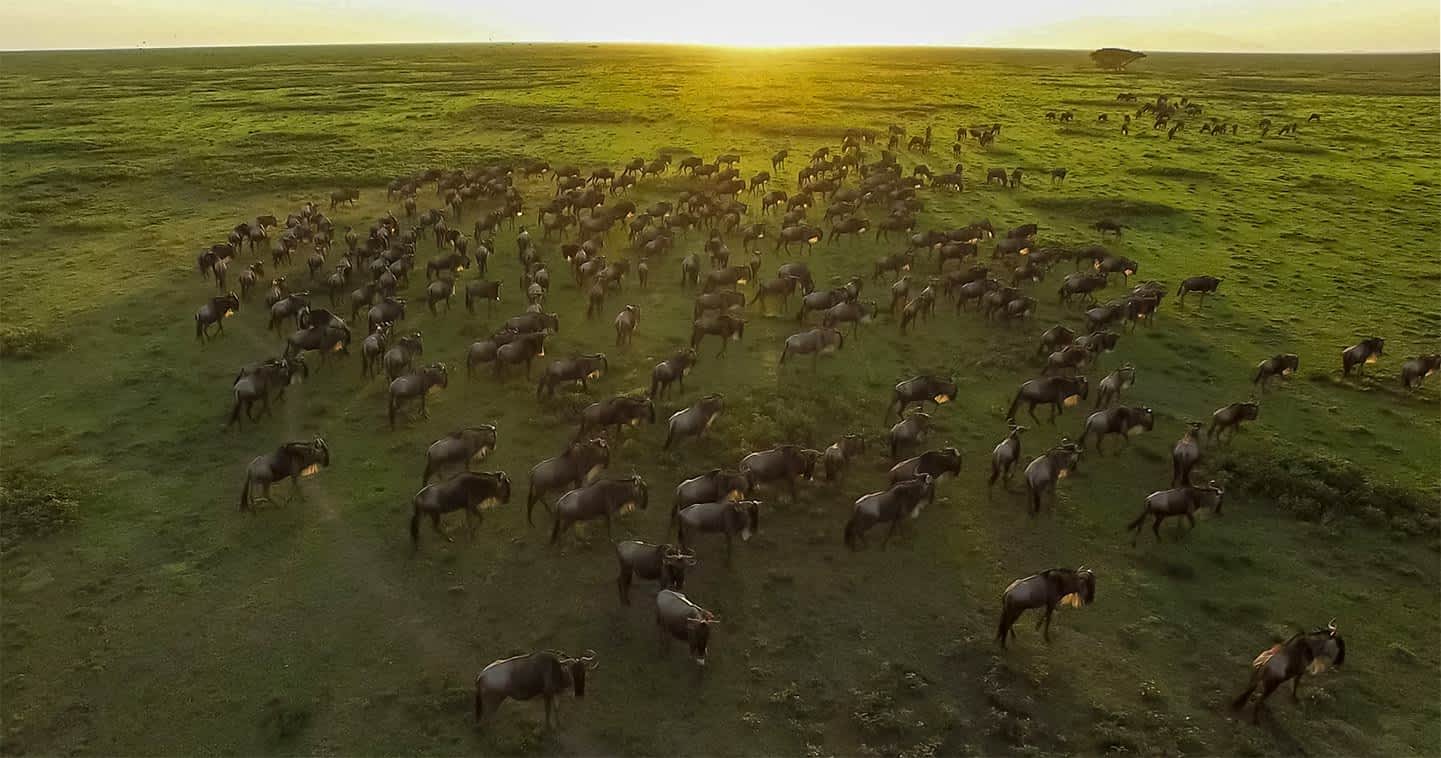
The Great Wildebeest Migration is the largest terrestrial mammal movement on the planet. Over one million wildebeest, joined by hundreds of thousands of zebras and gazelles, move continuously across the vast grasslands of northern Tanzania and southern Kenya. This movement forms a circular route that follows seasonal rainfall and grass regeneration, ensuring survival in an environment where resources are never evenly distributed.
What makes this phenomenon extraordinary is its permanence. There is no true beginning or end. Calving in the southern plains, long-distance movement across the Serengeti, dramatic river crossings, and eventual return all form part of a continuous ecological rhythm. Experiencing this cycle firsthand defines the life changing experience: great wildebeest migration, as it reveals nature not as a series of isolated events, but as a functioning system driven by time and necessity.
The Geography That Shapes the Migration
The migration is inseparable from the landscape it traverses. The expansive plains of Serengeti National Park provide the primary stage, offering nutrient-rich grasses that sustain massive herds. To the north, the ecosystem extends seamlessly into Masai Mara National Reserve, where seasonal rainfall draws animals across an international boundary that wildlife itself does not recognize.
These open grasslands are punctuated by rivers, woodlands, and ancient kopjes that shape movement and behavior. The Mara and Grumeti Rivers become focal points of risk and decision-making, where herds must cross crocodile-infested waters to access fresh grazing. This interplay between land and life is central to why the life changing experience: great wildebeest migration feels so complete and uncompromising.
Scale as an Emotional Force
Many safari experiences focus on individual encounters: a lion pride at rest, an elephant herd at a waterhole, a leopard draped across a tree branch. The Great Wildebeest Migration shifts this perspective entirely. Individual animals dissolve into a collective force that stretches beyond the horizon.
Standing before thousands of moving bodies generates an emotional response that words struggle to capture. Dust rises, hooves thunder, and the earth itself seems to vibrate. This overwhelming scale forces a reevaluation of human significance within the natural world. The life changing experience: great wildebeest migration often begins at this moment, when the sheer magnitude of life humbles the observer.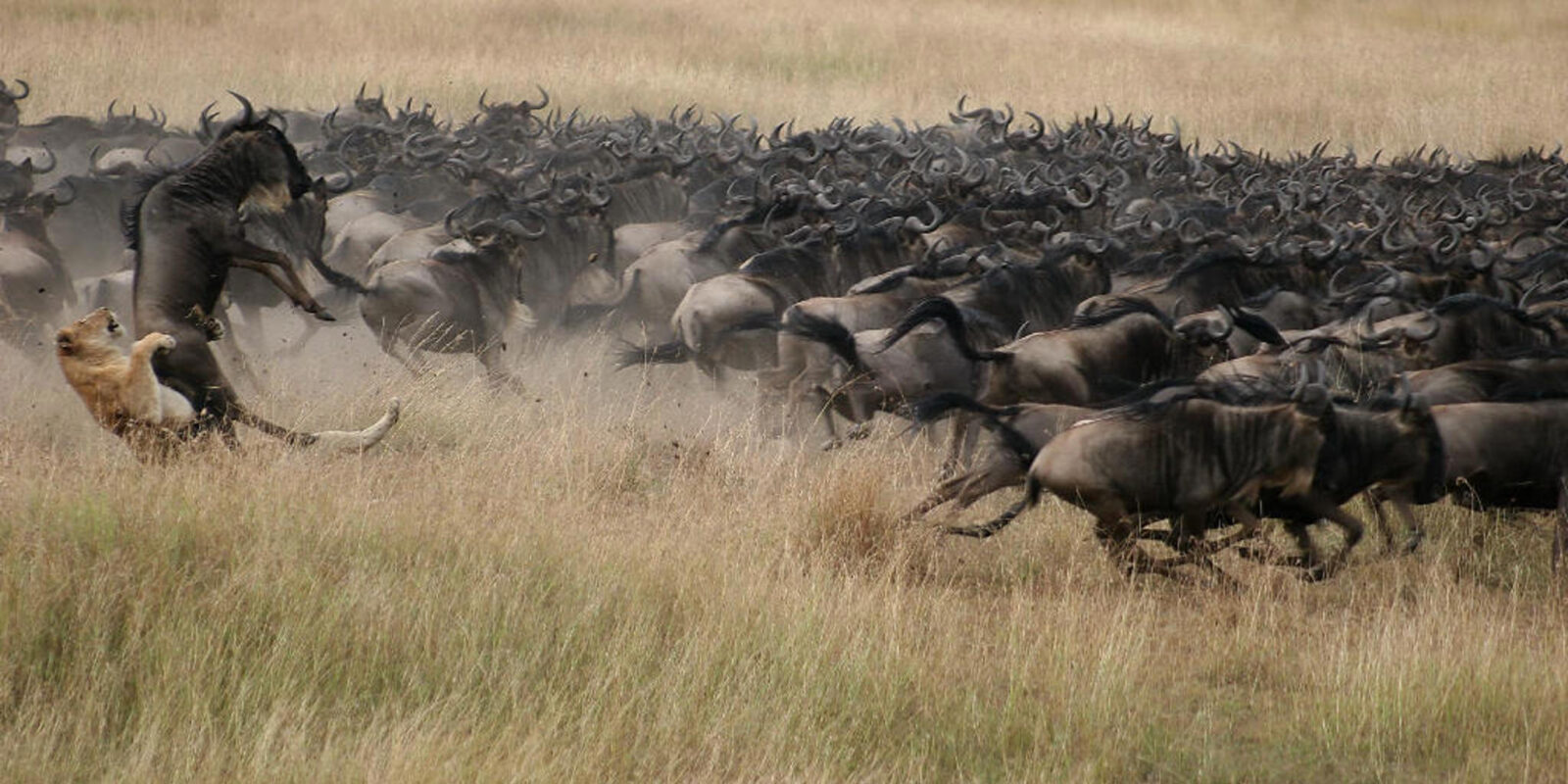
Birth and Vulnerability: The Calving Season
One of the most poignant phases of the migration occurs during the calving season in the southern Serengeti. Within a short span of weeks, hundreds of thousands of wildebeest calves are born, often within minutes of each other. This synchronized birthing strategy overwhelms predators through sheer numbers, ensuring that many calves survive.
Witnessing this phase introduces a powerful contrast. New life appears fragile and unsteady, yet instinct propels calves to stand and run within minutes. The life changing experience: great wildebeest migration is deeply shaped by this juxtaposition of vulnerability and resilience, reminding observers that survival begins at birth.
Predators and the Balance of the Ecosystem
Where the migration goes, predators follow. Lions, cheetahs, hyenas, and leopards position themselves strategically along migration routes. Crocodiles lie in wait at river crossings, their presence invisible until the moment of attack.
Predation during the migration is not gratuitous. It is necessary. It maintains ecological balance and ensures the health of both predator and prey populations. Observing this interaction can be emotionally challenging, yet it is integral to understanding the life changing experience: great wildebeest migration. Nature here is neither cruel nor kind; it is simply functional.
River Crossings as Defining Moments
River crossings are among the most iconic and emotionally charged aspects of the migration. Herds gather at riverbanks, hesitating for hours or even days before one animal makes the decision to jump. Once that choice is made, chaos and urgency follow.
The water churns with movement, crocodiles strike, and animals struggle against powerful currents. Not all survive. These moments are raw and unfiltered, leaving a lasting impression on all who witness them. The life changing experience: great wildebeest migration is often crystallized at these crossings, where survival hangs visibly in the balance.
Sound, Motion, and Sensory Immersion
The migration is not a silent phenomenon. The air fills with grunts, snorts, and the rhythmic pounding of hooves. Dust clouds reduce visibility, while the scent of earth and grass becomes pronounced.
This sensory immersion distinguishes the migration from other wildlife experiences. It is not observed from a distance; it surrounds you. The life changing experience: great wildebeest migration engages all senses simultaneously, creating memories that are as visceral as they are visual.
The Psychological Impact of Witnessing the Migration
Many travelers report a profound psychological shift after witnessing the migration. The experience disrupts modern assumptions about control, predictability, and comfort. Life here is dictated by forces far beyond individual will.
This confrontation with nature’s scale and indifference often leads to reflection. Priorities shift. Concerns that once felt urgent lose weight. The life changing experience: great wildebeest migration becomes a reference point for perspective, reminding observers of life’s fragility and continuity.
Seasonal Variations and Their Emotional Tone
The migration unfolds differently throughout the year, and each phase carries its own emotional resonance. Calving season emphasizes birth and renewal. Long-distance movement highlights endurance and determination. River crossings embody risk and consequence.
Regardless of timing, each season offers completeness. There is no inferior phase, only different expressions of the same cycle. This adaptability reinforces why the life changing experience: great wildebeest migration is not limited to a single moment, but exists throughout the year.
Light, Atmosphere, and the Migration Landscape
Light plays a powerful role in shaping the migration experience. Morning mist softens movement, while late-afternoon sun casts long shadows across the plains. Dust suspended in golden light creates scenes that feel almost timeless.
These atmospheric conditions heighten emotional impact. They transform wildlife observation into something closer to contemplation. The life changing experience: great wildebeest migration is as much about mood and atmosphere as it is about action.
Photography Versus Presence
The migration is one of the most photographed wildlife phenomena in the world. Yet many travelers find that the most meaningful moments resist documentation. Cameras struggle to capture scale, sound, and emotional weight.
Being present becomes more important than recording. The life changing experience: great wildebeest migration often imprints itself more deeply in memory than in images, reinforcing the value of attention over accumulation.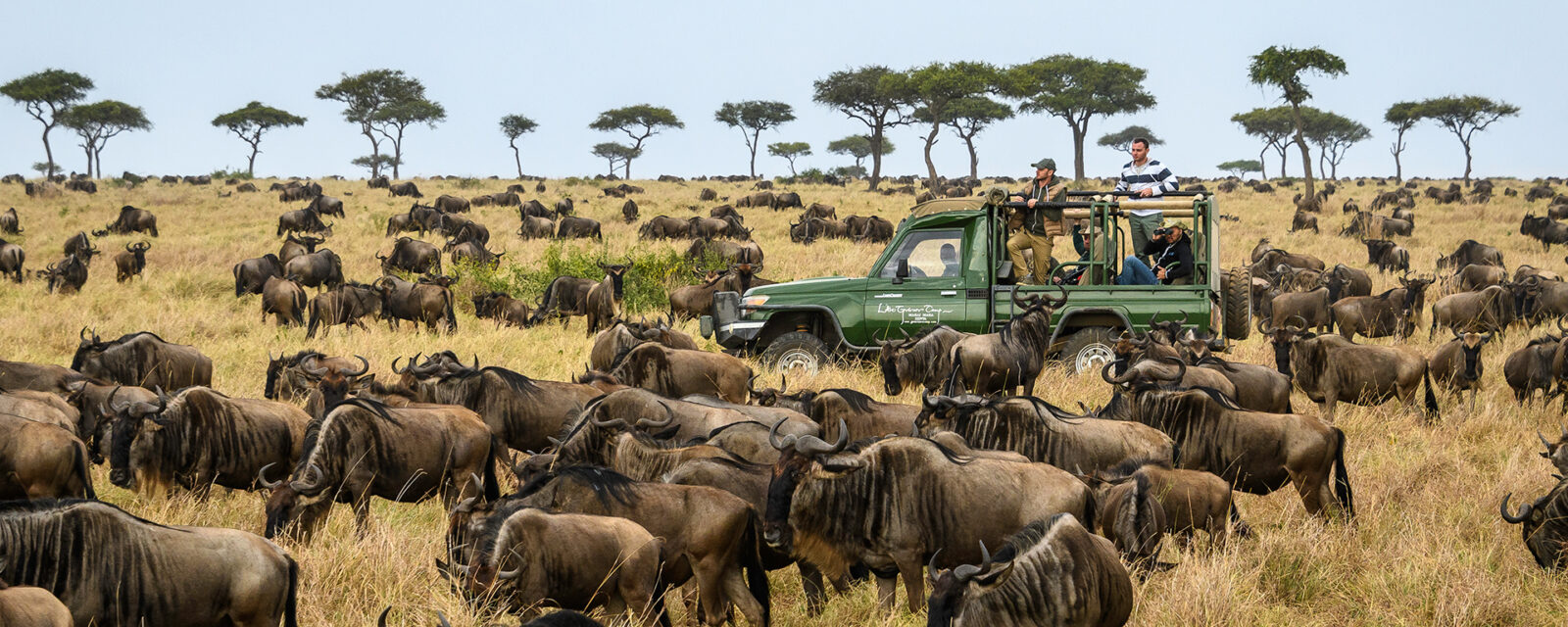
Conservation Lessons Embedded in the Migration
The existence of the Great Wildebeest Migration depends on the integrity of the Serengeti–Mara ecosystem. Protected corridors, responsible tourism, and cross-border conservation cooperation allow this phenomenon to continue.
Witnessing the migration highlights what is possible when large-scale ecosystems are preserved. It also underscores what could be lost if protection fails. The life changing experience: great wildebeest migration carries a conservation message that is both hopeful and urgent.
Cultural and Human Context
For communities living alongside the migration routes, this movement has shaped livelihoods, traditions, and identity for generations. The land is not empty wilderness, but a shared space where humans and wildlife coexist.
Understanding this context adds depth to the experience. The life changing experience: great wildebeest migration is enriched by recognizing that this natural phenomenon exists within a broader human story.
Why the Migration Feels Transformational
Transformation arises not from comfort, but from confrontation. The migration confronts observers with reality unfiltered by convenience. It shows life in motion, governed by instinct rather than intention.
This honesty resonates deeply. Many travelers leave with a renewed respect for natural systems and a desire to engage more responsibly with the world. The life changing experience: great wildebeest migration reshapes values as much as memories.
Comparing the Migration to Other Wildlife Experiences
While many destinations offer exceptional wildlife sightings, few offer continuity and scale. Individual encounters impress; the migration overwhelms.
It contextualizes all other safari experiences, revealing how individual animals fit into a larger ecological narrative. The life changing experience: great wildebeest migration becomes the benchmark against which other wildlife encounters are measured.
Who Is Most Affected by the Migration Experience
The migration resonates with travelers who seek depth rather than spectacle. Naturalists, photographers, conservationists, and reflective explorers often find it profoundly moving.
First-time safari travelers and seasoned explorers alike are affected, because the migration transcends expectation. The life changing experience: great wildebeest migration speaks to something universal, regardless of background.
Why the Migration Leaves a Permanent Impression
Long after the journey ends, memories resurface unexpectedly. The sound of hooves, the image of endless movement, or the tension of a river crossing returns with clarity.
These impressions persist because they connect to fundamental truths about life and survival. The life changing experience: great wildebeest migration does not fade; it integrates into personal perspective.
The Timelessness of the Great Migration
The migration has occurred for millennia and will continue as long as the ecosystem remains intact. Witnessing it connects travelers to a timeline far older than modern civilization.
This sense of timelessness adds weight to the experience. The life changing experience: great wildebeest migration is not just a journey through space, but through time.
Why This Experience Truly Changes Lives
Ultimately, the Great Wildebeest Migration changes lives because it reveals reality without ornament. It shows birth, struggle, cooperation, and loss as inseparable elements of existence.
The life changing experience: great wildebeest migration leaves observers quieter, more grounded, and more aware of their place within the living world. It is not simply seen. It is felt, remembered, and carried forward as a permanent shift in understanding.