search
the bahai temple uganda

Bahai temple

By Uganda places to visit, Where to go

The Bahá’í Temple Uganda: A Beacon of Unity, Spirituality, and Architectural Grace

Perched gracefully on the rolling hills of Kampala, the Bahá’í Temple Uganda stands as a symbol of global unity, peace, and spiritual inclusiveness. Its tranquil ambiance and striking architecture often surprise first-time visitors, especially those unfamiliar with the Bahá’í Faith. Yet for those who venture through its serene gardens and under its imposing dome, a profound sense of harmony and reflection awaits. As the only Bahá’í House of Worship on the African continent, and one of only a handful worldwide, this temple is not just a religious monument—it is a living testimony to humanity’s shared spiritual heritage and Uganda’s prominent role in promoting religious diversity.

This sacred edifice has, for decades, remained a hidden gem among Uganda’s spiritual and architectural landmarks, inviting pilgrims, tourists, scholars, and peace-seekers alike to explore its deeper meaning. The Bahá’í Temple Uganda is not just visited—it is experienced, spiritually and emotionally.

Location: The Spiritual Heart on the Hills of Kampala

Strategically located on Kikaya Hill, just about 6 kilometers from the center of Kampala, Uganda’s bustling capital, the Bahá’í Temple rises above the skyline like a celestial crown. This verdant hill offers panoramic views of the surrounding cityscape, yet feels removed enough to allow an atmosphere of quietude and contemplation.

Set amidst 52 acres of pristine gardens, the temple is not only admired for its religious significance but also cherished as a tranquil refuge for Kampala’s urban dwellers. Its elevated location, surrounded by indigenous flora and shaded walking paths, makes it a natural haven—a true escape into spiritual and environmental serenity.

How to Get There: An Accessible Journey to Sacred Ground

Reaching the Bahá’í Temple is both convenient and rewarding. The temple is located along Gayaza Road, which branches off from the bustling city center. Visitors can use private transportation or hail a local taxi or boda-boda (motorcycle taxi), which is both economical and efficient.

From Entebbe International Airport, the journey by car takes about one to one and a half hours, depending on traffic. Travelers who choose to use public transportation can board a commuter taxi from downtown Kampala heading towards Gayaza, alighting near the Kikaya Hill junction, from where a short uphill walk leads to the temple gates.

Regardless of the mode of transport, the trip itself gradually transitions from urban bustle to green tranquility—a fitting prelude to the spiritual calm that awaits at the summit.

Attractions: A Fusion of Faith, Art, and Nature

The most striking feature of the Bahá’í Temple is undoubtedly its unique architecture. Officially known as the Bahá’í House of Worship, this majestic structure was completed in 1961, making it the first Bahá’í temple on the African continent. Rising to a height of 124 feet, its towering nine-sided dome was meticulously designed to reflect the Bahá’í principle of unity.

Each of the nine sides represents the unity of the world’s major religions, a central tenet of the Bahá’í Faith, which believes that all spiritual traditions share a common divine origin. This symbolic design is enhanced by the absence of clergy, icons, or ritualistic ceremonies inside the temple. Instead, all are welcome to enter, pray silently, or read from the sacred texts of various world religions.

The surrounding gardens and terraces are equally alluring. Carefully curated walkways wind through landscaped gardens filled with flowering trees, medicinal plants, and indigenous species, offering both aesthetic pleasure and ecological value. The well-maintained lawns, occasionally dotted with prayerful visitors or quiet readers, create a deeply reflective environment.

Equally notable is the Bahá’í administrative center and library, located within the compound. These facilities preserve historical records of the Bahá’í Faith in Africa, and often host seminars and dialogues focused on interfaith harmony, education, and community development.

Things to Do: More Than Just a Visit

A visit to the Bahá’í Temple Uganda offers more than just sightseeing—it is an immersion into a philosophy of unity, peace, and global citizenship. While entry to the temple is free, the spiritual value it offers is immeasurable.

Visitors often choose to spend time inside the main sanctuary, where silence is both respected and therapeutic. Here, readings from sacred texts of all major religions are conducted periodically, reaffirming the Bahá’í belief in the oneness of God and the interconnectedness of all people.

Strolling through the gardens provides another layer of fulfillment. These walks are often accompanied by self-reflection or spontaneous spiritual conversation with other visitors. For students and scholars of religion or history, engaging with local Bahá’ís or accessing the small library reveals rich insights into the expansion of the Bahá’í Faith in East Africa, particularly during colonial and post-independence times.

Photography enthusiasts also find the site rewarding, especially during early morning or sunset hours, when the dome glows warmly under natural light, offering unforgettable imagery against the Kampala skyline.

Occasionally, community events, interfaith dialogues, and youth gatherings are held on the premises. These forums promote the Bahá’í ideals of education, gender equality, service to humanity, and sustainable development, inviting both adherents and non-members to participate in shaping a better world.

Best Time to Visit: Seasons of Peace and Bloom

Uganda, often referred to as “The Pearl of Africa,” enjoys a temperate tropical climate, and the Bahá’í Temple can be visited year-round. However, the most ideal months are during the dry seasons—from December to February and June to August—when the skies are clear, and the gardens are at their most vibrant.

During these periods, the well-maintained paths remain dry and easily walkable, allowing uninterrupted exploration of the grounds. The flora also blooms beautifully under the equatorial sun, enhancing the already picturesque setting with bursts of color and fragrance.

Mornings and late afternoons are particularly serene, as the soft light enhances the architectural grandeur of the dome while the cooler temperatures make it perfect for meditative walks. Those seeking solitude may prefer weekdays, while weekends see a slightly higher number of visitors, including local families and worshippers.

A Living Testament of Uganda’s Religious Pluralism

What sets the Bahá’í Temple apart from other spiritual landmarks in Uganda is not just its global significance, but the remarkable harmony it symbolizes. At a time when religious divides can often dominate headlines, this temple quietly stands as a testament to unity in diversity. Uganda, a country that is home to a mosaic of faiths, has proudly hosted this Bahá’í beacon for over six decades, making it a centerpiece of interreligious tolerance and peaceful coexistence.

The Bahá’í Temple is not only an architectural jewel; it is also an ideological light tower, calling attention to the universal values of love, understanding, justice, and the collective evolution of humanity. It reinforces the notion that different beliefs do not have to mean division—that shared values can triumph over superficial differences.

Why the Bahá’í Temple Deserves a Place on Your Uganda Itinerary

For travelers, pilgrims, and cultural explorers, a journey to the Bahá’í Temple Uganda is more than just a tick on an itinerary. It is a soul-stirring encounter with a faith that respects all others, a walk through manicured gardens that mirror the inner garden of reflection, and an invitation to embrace peace in its purest form.

Whether one is religious or secular, the site’s power lies in its ability to evoke a deeper connection to the human spirit. In a continent rich with natural wonders, wildlife, and adventure, the Bahá’í Temple adds a quieter, more reflective dimension to the East African experience—one that is equally transformative.

Book Your Spiritual and Safari Experience with WildHorn Africa

To fully discover Uganda’s diverse offerings—from its spiritual landmarks like the Bahá’í Temple to its world-renowned national parks and cultural sites—expert guidance makes all the difference. That’s why travelers are encouraged to plan their African tours and safaris through WildHorn Africa.

With a reputation for excellence, local insight, and ethical travel practices, WildHorn Africa curates customized, unforgettable journeys that seamlessly blend spiritual exploration, cultural immersion, and thrilling adventure. Whether you seek moments of deep peace or the pulse of the wild, your journey will be crafted with care, knowledge, and passion.

Uganda museum

Uganda museum

By Uganda places to visit, Where to go

Uganda Museum: A Timeless Vault of the Nation’s Heritage

Standing quietly at the edge of Kampala’s bustling heart is a treasure trove that whispers the story of Uganda — a nation of kingdoms, warriors, artisans, musicians, and innovators. The Uganda Museum is more than a building of aged exhibits; it is a living chronicle of identity, a cultural mirror, and a national memory bank that continues to evolve with time. Within its modest walls lies the pulse of Uganda’s journey — from the dawn of prehistoric life to the complexity of modern statehood.

Founded in 1908, the Uganda Museum holds the distinction of being the oldest museum in East Africa. While its architecture may appear understated at first glance, what it houses is profound: the preservation of indigenous knowledge systems, the celebration of tribal diversity, and the continuity of Ugandan identity in the face of globalization and modern transformation. Every object here — from musical instruments to Iron Age tools — carries a story. And when pieced together, these stories form the mosaic of Uganda’s past, present, and projected future.

Location: A Cultural Heartbeat in the Capital

The Uganda Museum is strategically situated in Kampala, Uganda’s capital city, along Kira Road in Kamwokya, just a few minutes’ drive from the central business district. This location is not only easily accessible but also symbolically powerful. It allows the museum to serve as a cultural anchor in a city rapidly transforming through skyscrapers, digital hubs, and commercial complexes.

Set within an expansive compound, shaded by age-old trees and encircled by gardens, the museum provides a sense of serenity amidst the city’s energetic hum. Its grounds host not only permanent structures but also outdoor exhibits — particularly in ethnography and traditional architecture — creating an open-air learning environment that blends natural space with heritage education.

How to Get There: Gateway to the Past in the Heart of the Present

Reaching the Uganda Museum is remarkably easy for both locals and international visitors. From Entebbe International Airport, the museum lies approximately 40 kilometers away, a journey that takes about an hour by car, depending on traffic. Visitors arriving in central Kampala can access the site via public transport, private taxis, or organized tour groups.

Most major hotels and guest houses in the city offer shuttle services or assistance with arranging guided visits. For those using public means, boda bodas (motorbike taxis) and commuter taxis traveling along Kira Road are common and cost-effective options. Signage to the museum is clear, and security at the premises is maintained consistently, making it a safe destination for all types of travelers.

Attractions: A Journey Through Uganda’s Diverse Civilizations

The Uganda Museum’s charm lies not in high-tech displays or modern interactive installations, but in the depth and authenticity of its collections. Walking through its galleries feels like a passage through centuries, a carefully curated journey that honors each period of Uganda’s expansive narrative.

The Ethnography Gallery is perhaps the most emotionally powerful, showcasing traditional regalia, ceremonial costumes, weaponry, and household items from Uganda’s numerous tribes. Here, the visitor encounters the cultural expressions of the Baganda, Banyankole, Acholi, Iteso, Basoga, Batooro, and many other communities — each display offering insight into values, cosmologies, and lifeways.

Equally captivating is the Archaeology and Paleontology section, where ancient tools, pottery fragments, and skeletal remains tell the story of early human settlement in the region. Fossils of prehistoric mammals, including a jawbone of the now-extinct Ugandapithecus major, offer compelling evidence that Uganda was once a cradle of early primate evolution. The Iron Age exhibit demonstrates technological advancements in smelting and metallurgy, showcasing how early Ugandan societies forged tools and weapons long before the arrival of colonial powers.

Another standout is the Natural History collection, featuring an array of taxidermied wildlife, geological specimens, and models of Uganda’s varied ecosystems. This section serves as a miniature encyclopedia of the country’s rich biodiversity — from the elephants of Queen Elizabeth National Park to the butterflies of Mabira Forest.

Outside, the museum’s grounds host life-sized reconstructions of traditional huts from different regions of the country. These dwellings, built using authentic materials and architectural techniques, allow visitors to step inside the lived experiences of precolonial Uganda. Complementing these are displays of ancient granaries, dug-out canoes, and musical installations where guests can try their hand at indigenous instruments like the adungu, amadinda, and engalabi.

Things to Do: An Immersive Cultural Experience

A visit to the Uganda Museum offers far more than passive observation. Guests are invited into an interactive engagement with Uganda’s heritage, one that combines education, curiosity, and cultural empathy.

Guided tours, led by seasoned curators and historians, provide deep dives into the symbolism, origin, and evolution of specific artifacts. These experiences often expand beyond the facts, offering storytelling and oral history components that animate the objects with voices from the past.

Students and researchers benefit from access to the resource library, which houses a wealth of archival material, ethnographic studies, and academic papers on Ugandan history, archaeology, and culture. Special exhibitions are hosted periodically, often focusing on underrepresented themes such as women in traditional society, precolonial justice systems, or indigenous healing practices.

Workshops and cultural events also breathe life into the museum’s mission. These include traditional dance performances, craft-making demonstrations, art exhibitions, and storytelling sessions designed for both children and adults. Visiting the museum during these events allows for a multi-sensory appreciation of Uganda’s intangible heritage.

For photographers and creatives, the museum’s aesthetic — a blend of colonial-era architecture, outdoor exhibitions, and rich artifacts — provides ample inspiration for capturing the fusion of Uganda’s past and present.

Best Time to Visit: When History Shines Brightest

The Uganda Museum remains open year-round, but certain periods offer enhanced experiences. The dry seasons, from June to August and December to February, are ideal for visiting, particularly if one plans to explore the outdoor exhibits. The clear skies and moderate temperatures make for comfortable walking tours and allow for optimal photography, especially around the traditional huts and garden areas.

These months also coincide with school holidays and cultural festivals, meaning visitors might encounter live events, exhibitions, or special community programs. That said, even the rainy seasons bring their own charm — the lush green surroundings provide a tranquil ambiance, and the indoor galleries offer perfect refuge for those seeking quiet contemplation.

A Heritage Worth Preserving

The Uganda Museum is not just a relic of the past but a living cultural institution that plays an active role in nation-building. It has weathered political transitions, ideological shifts, and budgetary challenges, yet it stands — not just as a repository of artifacts, but as a keeper of memory, a teacher of truth, and a bridge between generations.

At a time when Africa’s heritage is often threatened by neglect, urbanization, or even foreign repatriation debates, the Uganda Museum reminds the world that history belongs to those who preserve it. It challenges both Ugandans and visitors to reflect, not only on what has been lost, but on what must be protected for the future.

Whether one is a scholar, a student, a traveler, or a curious observer, a visit to the Uganda Museum provides more than facts. It offers perspective, continuity, and a deepened understanding of one of Africa’s most complex and captivating nations.

Explore Uganda’s Living History with WildHorn Africa

To truly uncover the depth and beauty of Uganda’s cultural and historical landscape, entrust your journey to WildHorn Africa — a tour company known for its authentic, immersive, and tailor-made experiences. Whether it’s a visit to the Uganda Museum, a spiritual pilgrimage to ancient shrines, or a wildlife adventure in the savannas, WildHorn Africa designs safaris that go beyond sightseeing — into the very soul of the continent.

With expert guides, seamless logistics, and a passion for storytelling, WildHorn Africa transforms every trip into a life-changing memory.

Walumbe Tanda pits of death in Uganda

Walumbe Tanda pits of death

By Uganda places to visit, Where to go

Walumbe Tanda Pits of Death: Where Myth and Mortality Collide

Tucked deep within the gentle hills of Central Uganda lies a mysterious place where the boundary between myth and reality grows thin — a site that has inspired awe, fear, reverence, and fascination for generations. The Walumbe Tanda Pits of Death are not just natural depressions in the earth. They are an ancient, sacred landscape tied to the origins of death itself in Buganda mythology. Here, in the stillness of the forest floor, the past breathes, and the voices of ancestors echo through the rustling leaves and whispering winds.

To visit the Tanda Pits is not merely to witness a natural formation — it is to step into a world where oral tradition and cosmology merge, offering a rare opportunity to confront one of the most powerful narratives in African mythology. This is where Walumbe, the bringer of death, is said to have descended into the earth, leaving behind dozens of pits as symbols of his refusal to surrender. The ground here is hallowed, not because of what is seen, but because of what it represents — a confrontation with the mystery of death and the endurance of culture.

Location: Rooted in the Heart of Buganda

The Walumbe Tanda Pits are located in Tanda Village, in Mityana District, approximately 65 kilometers west of Kampala, Uganda’s capital. The site rests quietly within a shaded woodland area just off the Mityana–Kampala Road, a short drive from the bustling trading center of Mityana town. The surrounding region is largely agricultural, with homesteads and farmlands peppered across the rolling hills, but as one approaches the Tanda heritage site, the landscape shifts subtly. The air becomes stiller, the vegetation denser, and the spiritual weight of the place more palpable.

This area is considered sacred ground by the Baganda people, the largest ethnic group in Uganda. For them, the pits are a living part of their cosmological history, and Tanda remains one of the most significant mythological sites in the country. It is under the stewardship of local cultural custodians, who work closely with Buganda Kingdom representatives and heritage conservation bodies.

How to Get There: A Short Journey into the Depths of Legend

Accessing the Walumbe Tanda Pits from Kampala is relatively straightforward. The journey along the Kampala–Mityana Road typically takes around 90 minutes, depending on traffic conditions. Travelers may opt to use private vehicles or public transport such as minibuses and commuter taxis heading toward Mityana. Upon reaching Tanda trading center, a short dirt path leads to the forested area where the pits are located. The road is accessible year-round, though a four-wheel drive may be advisable during the rainy seasons due to occasional slipperiness.

Upon arrival, visitors are welcomed by local guides — most of whom are knowledgeable about Buganda’s mytho-historical traditions — and are introduced to the site through storytelling, ritual explanation, and interpretive walking tours.

Attractions: Where Earth Records a Cosmic Struggle

The primary attraction at Tanda is, of course, the dozens of circular pits scattered across the forest floor. Ranging in size and depth, these pits are believed to be the footsteps or escape tunnels created by Walumbe, the mythological figure responsible for introducing death to humanity. According to Ganda cosmology, Walumbe (whose name literally means “death” in Luganda) was the brother of Nambi, a celestial being who married a man of Earth named Kintu. When Walumbe followed his sister to Earth, he brought with him the curse of mortality, refusing to return to the heavens despite repeated pleas from Ggulu, the sky god.

Legend has it that in a final bid to capture Walumbe, emissaries from heaven descended to earth. As they chased him through Tanda, he repeatedly vanished into the ground, creating a series of pits to escape capture. These are the very indentations visible today — silent, solemn testaments to this dramatic celestial rebellion.

The site also features ritual trees, stone altars, and designated shrines where offerings are made by traditional practitioners and pilgrims. These attractions are not embellished or touristy; rather, they are respectfully preserved and interpreted, giving visitors an unfiltered experience of spiritual and cultural history.

Moreover, the forest ambiance adds to the mystique. The rustling leaves, birdsong, and occasional distant chants create a surreal auditory backdrop, making one feel as though they’ve stepped into an untouched spiritual realm.

Things to Do: A Journey of Reflection and Cultural Immersion

While Tanda does not offer the typical excitement of wildlife safaris or mountain hikes, it provides something perhaps more rare — a journey inward, toward understanding indigenous African cosmology and human mortality. A visit here invites meditative reflection, cultural learning, and spiritual exploration.

Engaging with the site custodians is one of the most enlightening aspects of the experience. These knowledgeable individuals not only guide visitors around the pits but also explain the deeper meanings embedded in the legend of Walumbe. They interpret the moral, philosophical, and spiritual dimensions of the myth, including what it reveals about the Ganda understanding of life, death, and ancestral continuity.

Occasionally, one may witness or participate in traditional rituals, where herbs are burned, prayers are chanted, and symbolic offerings are left at specific pits. These ceremonies are not performative but are living traditions — sacred acts intended to appease spirits, seek blessings, or mark important cultural anniversaries.

For researchers and students of African religion, folklore, or anthropology, Tanda offers firsthand access to one of the most enduring mythological traditions in East Africa. For photographers and nature lovers, the serene landscape and interplay of light and shadow in the forested pits provide excellent creative inspiration.

Best Time to Visit: Seasons of Spirit and Stillness

The Tanda Pits may be visited throughout the year, though the dry seasons — from June to August and December to February — offer the most favorable conditions. During these months, the forest paths remain dry, the visibility clear, and ceremonies more frequent. The calm weather allows for extended exploration and a more comfortable walking experience across the sacred site.

The rainy seasons, while more challenging in terms of mobility, present a different kind of magic. The site becomes lush, the forest denser, and the pits even more hauntingly beautiful with fresh foliage and the soft echo of rain on the canopy. For those seeking solitude and reflection, the rains amplify the spiritual ambiance.

Visitors are encouraged to come with an open heart and respectful curiosity, for Tanda is not merely a place to be toured — it is to be experienced in reverence.

The Relevance of Tanda in a Modern World

In today’s fast-paced, secularizing society, the Walumbe Tanda Pits stand as a rare window into humanity’s eternal questions — about where we come from, what it means to live, and why we must die. The myth of Walumbe is not just folklore; it is a cultural philosophy that frames death not as an end, but as a condition of existence that shapes human identity and spiritual practice.

For the Baganda, Tanda is not a relic of the past, but a living spiritual site that continues to inform rituals, family traditions, and moral teachings. In visiting this sacred ground, travelers are not simply observers — they are participants in a deeper dialogue between past and present, spirit and soil.

Begin Your Spiritual and Cultural Journey with WildHorn Africa

To explore the Walumbe Tanda Pits of Death and other powerful cultural landmarks in Uganda, trust the expertise and care of WildHorn Africa. With years of experience crafting meaningful, immersive, and respectful tours across the continent, WildHorn Africa specializes in bringing you closer to the heart of Africa’s hidden stories.

From mythological landscapes and royal tombs to wildlife safaris and mountain treks, every WildHorn Africa journey is tailor-made to enlighten, inspire, and transform. Begin your exploration of Uganda’s ancient wonders with a team that knows Africa — not just as a destination, but as a sacred narrative waiting to be told.

Nakayima Tree

Nakayima Tree

By Uganda places to visit, Where to go

Nakayima Tree: The Sacred Sentinel of Uganda’s Spiritual Heritage

Towering over the landscape of Mubende Hill like an ancient sentinel, the Nakayima Tree is far more than a natural marvel. It is a spiritual symbol, a cultural monument, and a living connection to the mystical past of Uganda’s Bantu-speaking peoples. Wrapped in legend and rooted in centuries of indigenous worship, this majestic tree continues to draw pilgrims, historians, and curious travelers alike, offering an unparalleled glimpse into Uganda’s rich spiritual and cultural identity.

In an age where modernity steadily encroaches on tradition, the Nakayima Tree stands as a timeless reminder of the deep, enduring relationship between the environment and African spirituality. Every twisted root, gnarled branch, and hollow chamber of this tree tells a story — one that transcends physical beauty and delves into ancestral reverence, oral history, and cultural continuity.

Location: Perched on the Storied Slopes of Mubende Hill

The Nakayima Tree is located in Mubende District, in central Uganda, approximately 150 kilometers west of Kampala. It majestically crowns the peak of Mubende Hill, which rises to about 1,530 meters above sea level, offering not only spiritual insight but also panoramic views of the lush countryside that spreads out beneath it.

This site is more than just a geographical marker; it is considered a sacred space that has served as a spiritual center for the Bachwezi, a legendary dynasty said to possess semi-divine attributes. The tree’s location on Mubende Hill, a site that once hosted a powerful royal palace, further elevates its importance in Uganda’s historical and mythical narratives.

How to Get There: A Pilgrimage of Discovery

Reaching the Nakayima Tree from Kampala involves a journey westward along the well-paved Kampala–Fort Portal Road. The drive takes approximately 3 to 4 hours, passing through verdant landscapes, trading centers, and coffee plantations that are emblematic of Uganda’s fertile heartland. Upon reaching Mubende town, visitors ascend the steep slopes of Mubende Hill, either by foot or motorbike, navigating the winding path that leads to the summit where the tree awaits.

This journey, though physically modest, often feels like a spiritual pilgrimage, drawing the traveler into a deeper consciousness of Uganda’s sacred geography. Local guides and caretakers, often linked to the shrine’s custodianship, are available to lead the final leg of the ascent while sharing rich oral traditions associated with the site.

Attractions: Where Nature and Myth Converge

What captivates visitors most about the Nakayima Tree is not merely its physical form, although that alone is astounding. The tree, believed to be over 600 years old, belongs to the Ficus natalensis species — commonly referred to as the bark-cloth fig tree. Its enormous trunk, which measures several meters in diameter, gives way to expansive aerial roots that cascade like curtains, forming hollow chambers and archways that evoke the imagery of a natural cathedral.

These inner hollows serve as shrines, each dedicated to different spirits or ancestral entities. The most prominent is the shrine to Nakayima, a legendary spirit medium believed to have served King Ndahura, one of the Bachwezi rulers. Oral history recounts that Nakayima did not die but mysteriously vanished into the tree, hence the belief that her spirit still inhabits it.

Every inch of the tree’s structure seems infused with mystery — from the soot-stained niches where offerings have been made for generations, to the symbols etched into its bark, and the lingering scent of herbs and incense used in rituals. For many, the Nakayima Tree is a living oracle, a place where prayers are offered, blessings are sought, and ancestral guidance is received.

Things to Do: Engage with Uganda’s Mystical Legacy

Visitors to the Nakayima Tree are invited into a realm of ritual and reflection. Upon arrival, one is often welcomed by traditional custodians, often women known as priestesses or mediums, who maintain the site and facilitate rituals. These women are guardians of ancient knowledge and serve as intermediaries between the physical world and the spirit realm.

Participating in or observing a traditional ceremony — which may include chants, libations, drumming, and the burning of herbs — offers a deeply immersive experience into indigenous belief systems that have endured for centuries. Visitors are encouraged to engage respectfully, asking questions and observing with humility as they are introduced to Uganda’s pre-colonial spiritual systems.

Beyond the rituals, the surrounding hill offers a serene environment for quiet meditation, panoramic photography, and historical reflection. The ruins of the former palace of King Ndahura, marked by scattered earthworks and ancient stone foundations, provide valuable insight into the region’s political and spiritual prominence in earlier centuries.

For those with academic or cultural interest, the Nakayima Tree also serves as a research gateway into the realms of ethnobotany, oral history, and comparative mythology, offering an ideal case study on the intersection of nature, culture, and spirituality in African societies.

Best Time to Visit: Embracing the Season of the Spirits

Though the Nakayima Tree can be visited throughout the year, the dry seasons, occurring between June and August, and again from December to February, are considered the most favorable. During this time, the path up Mubende Hill remains dry and accessible, while the clear skies enhance the visibility of the surrounding landscape.

It is during these dry months that ceremonial activity tends to increase, particularly around traditional festivals or spiritual calendar events, offering a more vibrant and engaging visitor experience. However, the rainy seasons also have their charm — the tree appears even more alive, its leaves greener, and its spiritual aura heightened by the sounds of rainfall and the mist that often cloaks the hilltop in early mornings.

A Cultural Heritage Under Pressure

While the Nakayima Tree remains protected under Uganda’s cultural heritage framework, it faces challenges from deforestation, urban encroachment, and cultural erosion. Efforts have been made by local authorities, cultural institutions, and NGOs to promote its conservation, not merely as a tourist site, but as a sacred living monument.

These initiatives include community-based tourism models, environmental education, and spiritual heritage documentation — all aimed at ensuring the continuity of the site’s traditional practices while opening it up to respectful global appreciation. Visitors are encouraged to support these efforts by engaging ethically, donating to preservation initiatives, and acknowledging the tree’s significance beyond aesthetics.

Where Legends Live in Bark and Root

The Nakayima Tree is not simply a natural attraction; it is a gateway into Uganda’s soul. In its colossal form resides a fusion of history, mythology, and identity — an unbroken thread connecting the past with the present. It speaks to a time when trees were temples, spirits walked among men, and the land itself was revered as sacred.

To stand before the Nakayima Tree is to feel the hum of time, the weight of forgotten kingdoms, and the whisper of ancestors in the rustling leaves. It is a place that demands reverence, inspires wonder, and invites reflection on humanity’s place within nature’s larger story.

For the culturally curious traveler, the spiritually inclined pilgrim, or the academic seeking depth, the Nakayima Tree offers an experience unlike any other in Uganda — one that is not merely seen, but deeply felt.

Explore Uganda’s Mystical Wonders with WildHorn Africa

To truly appreciate the Nakayima Tree and Uganda’s vast tapestry of spiritual, cultural, and ecological heritage, your journey deserves expert curation. WildHorn Africa, a premier provider of tailor-made safaris and immersive tours, offers travelers an opportunity to explore beyond the surface, with journeys crafted around authentic experiences, local knowledge, and responsible travel practices.

Whether you’re drawn to ancient shrines, wildlife sanctuaries, or the hidden paths of oral history, trust WildHorn Africa to design a tour that leaves you both enchanted and enlightened.

Mpanga Forest

Mpanga Forest

By Uganda places to visit, Where to go

Mpanga Forest: A Verdant Gem of Uganda’s Central Region

Amidst the rolling plains and urban bustle of Central Uganda lies a pocket of green serenity that has withstood the test of time and change — Mpanga Forest, a captivating natural treasure just outside the capital, Kampala. Revered not only for its biodiversity but also for its profound ecological significance, this medium-altitude tropical forest remains one of Uganda’s best-kept secrets for eco-tourism and scientific exploration.

A Living Relic: Understanding the Essence of Mpanga Forest

Mpanga Forest is more than just a collection of trees and trails — it is a living ecosystem, humming with the vitality of ancient roots and teeming with organisms that tell the story of evolution, adaptation, and resilience. Spanning over 453 hectares, the forest was initially gazetted in 1950 as a scientific research site for sustainable forestry. However, it soon gained popularity among nature enthusiasts and educational institutions due to its rich botanical diversity, abundant birdlife, and tranquil atmosphere.

This forest represents a critical remnant of Uganda’s natural lowland forests, many of which have been degraded or lost to agricultural expansion and urban development. Its preservation remains crucial, not only for the conservation of biodiversity but also as a climate regulator and educational hub.

Location: Nestled in the Heart of Central Uganda

Mpanga Forest Reserve is strategically located in Mpigi District, approximately 37 kilometers southwest of Kampala, along the Kampala–Masaka Highway. It lies at the intersection of Uganda’s expanding urban landscape and rural farmlands, creating a unique buffer zone where modern development and nature collide.

Its close proximity to the capital has made Mpanga Forest one of the most accessible natural attractions for both domestic and international travelers. This nearness allows for convenient day trips while offering the full immersion of an authentic forest experience — a rare balance in today’s fast-developing world.

How to Get There: A Journey into the Green

Reaching Mpanga Forest is an experience that begins long before the forest canopy is in sight. The road from Kampala to Mpigi is a scenic stretch, where the cityscape gradually melts into verdant hills and banana plantations. A private vehicle or organized tour is often preferred for comfort, although public transport options such as minibuses (matatus) headed to Masaka can also get visitors to Mpigi town, from where local motorcycles (boda bodas) complete the final leg of the journey.

The journey takes just over an hour under normal traffic conditions, making it one of the most accessible natural forests in Uganda for researchers, birders, and weekend explorers.

Attractions: Nature’s Architecture and Avian Melodies

What truly sets Mpanga Forest apart is not merely its accessibility, but the sheer richness of life that pulses through its undergrowth, treetops, and streams. The forest boasts over 500 species of trees and shrubs, many of which are endemic or hold medicinal value. Towering fig trees with wide buttress roots and dense mahogany stands create a surreal, almost cathedral-like atmosphere, where shafts of sunlight pierce the canopy and illuminate the forest floor.

Mpanga is particularly famed for its birdlife, with more than 200 species recorded, making it a cherished destination for ornithologists. Species such as the White-spotted Flufftail, the Grey Parrot, and the Forest Wood-Hoopoe can be spotted or heard, their calls echoing through the quiet glades. Butterflies, numbering in the hundreds of species, add color and motion, while red-tailed monkeys, bush babies, and squirrels animate the branches and pathways.

Of unique ecological value is the Mpanga River, which snakes through the forest and supports aquatic life while adding a dynamic element to the ecosystem. Its presence nurtures the moist microclimate necessary for amphibians and mosses to thrive.

Things to Do: Immersive Encounters with Nature

Visitors to Mpanga Forest are invited not to rush, but to slow down and tune in to the rhythms of nature. The forest offers a variety of walking trails, ranging from short loops to longer interpretive hikes that wind through different ecological zones. These trails are ideal for birdwatching, botanical study, and quiet meditation, offering opportunities for both adventure and introspection.

Nature photography thrives here, as the changing light, diverse flora, and mobile fauna provide endless subjects for the lens. Educational tours are regularly conducted for schools and researchers, focusing on forest ecology, conservation practices, and plant identification.

In the cooler hours of early evening, the forest reveals yet another layer of intrigue — nocturnal walks. Guided by forest rangers, these walks introduce visitors to the secret world of night creatures, such as bush babies, nocturnal birds, and various insects that come alive under the cover of darkness.

For those seeking a longer connection with the forest, simple accommodation facilities are available near the forest edge, including eco-lodges and tented camps, offering rustic yet comfortable stays. These allow for multi-day immersion into the forest, perfect for writers, researchers, or anyone looking to disconnect from digital distractions.

Best Time to Visit: When the Forest is Most Alive

While Mpanga Forest remains open to visitors year-round, the optimal time to visit falls within the dry seasons, typically from June to August and December to February. During these months, the trails are more navigable, and visibility for birding and photography is at its best. The weather remains pleasant, with mild temperatures and lower humidity, making it ideal for extended forest walks.

However, even the wet season has its unique charm. From March to May and again in September to November, the forest experiences increased rainfall, leading to a flush of new plant growth, breeding activity among birds and amphibians, and a noticeable rise in butterfly populations. While trails may be slippery, visitors during this season are often rewarded with sightings of rare species and a more mystical forest ambiance, often veiled in early morning mist.

Conservation Efforts: A Sanctuary Worth Protecting

Though small in size compared to Uganda’s larger forest reserves, Mpanga Forest plays a critical role in biodiversity conservation, particularly as a biological corridor and carbon sink. With increasing pressure from population growth, land encroachment, and climate change, the forest has become a focal point for community-based conservation efforts and environmental education.

Collaborative projects involving the National Forestry Authority (NFA), NGOs, local schools, and community leaders are in place to promote sustainable use of forest resources, tree planting, and responsible eco-tourism. Visitors are encouraged to support these efforts through entrance fees, donations, and by practicing low-impact tourism while in the forest.

Mpanga, More Than Just a Forest

In a world where wild spaces are disappearing at an alarming rate, Mpanga Forest remains a symbol of resilience, serenity, and scientific value. It invites travelers not just to witness nature, but to experience it intimately — through the rustling of leaves, the dart of a bird in flight, the stillness of an old tree, or the laughter of a child on a school trip discovering the forest for the first time.

To walk through Mpanga is to walk through history, biology, and the future of conservation — all at once. It is a destination not defined by grand gestures or sweeping landscapes, but by subtle miracles and quiet wonders that reward those who pay attention.

For those seeking a journey that combines education, adventure, and ecological insight, a visit to Mpanga Forest is an opportunity not to be missed.

Plan Your Next Adventure with WildHorn Africa

To fully experience the wonders of Mpanga Forest and other hidden gems across the continent, your journey deserves expert guidance. WildHorn Africa, a trusted name in bespoke African travel experiences, offers tailor-made safaris and eco-tours that prioritize conservation, comfort, and cultural authenticity. Whether it’s a forest walk in Mpanga or a gorilla trek in Bwindi, let WildHorn Africa craft the perfect adventure for you.

Budongo Forest

Budongo Forest

By Uganda places to visit, Where to go

Budongo Forest: Uganda’s Hidden Kingdom of Giants and Chimpanzees

Deep in the heart of northwestern Uganda, where the vast savannah of Murchison Falls National Park meets the lush embrace of the Albertine Rift, lies one of the most biologically rich and ecologically significant rainforests in East Africa—Budongo Forest. Known for its towering mahogany trees, abundant wildlife, and profound scientific history, Budongo remains one of Uganda’s best-kept secrets. To walk beneath its ancient canopy is to step into a world that has existed for millennia, largely untouched and teeming with life. It is not merely a forest; it is a natural cathedral, where the symphony of birdsong, rustling leaves, and primate calls narrates a living story of biodiversity, resilience, and wonder.

While Budongo Forest is celebrated for its habituated chimpanzees, what truly sets it apart is its harmonious blend of scientific significance, community conservation, and untouched wilderness. As Uganda continues to emerge as one of Africa’s premier eco-tourism destinations, Budongo quietly offers something extraordinary—a journey into the core of primal Africa, undisturbed and profound.

Location: Where Forest Meets the Falls

Budongo Forest is located in the northwestern region of Uganda, within the Masindi District, bordering the southern section of Murchison Falls National Park. Covering an expanse of over 825 square kilometers, it is the largest surviving natural forest in Uganda and forms part of the larger Budongo Conservation Area under the Uganda Wildlife Authority.

Resting at the edge of the Albertine Rift, Budongo’s location gives it a unique climatic and geological character. Its altitudes range from 700 to 1,100 meters above sea level, contributing to diverse microhabitats. The forest is part of the greater Murchison landscape, and its southern gate, known as Kaniyo Pabidi, serves as the primary entry point for eco-tourists and researchers alike. This strategic position enables Budongo to act as a crucial ecological corridor, supporting not just primates but also large mammals that move between forest and savannah biomes.

How to Get There: The Scenic Passage Through Western Uganda

The journey to Budongo Forest begins from Kampala, Uganda’s bustling capital. The most common route follows the Kampala–Masindi road, stretching approximately 230 kilometers northwest, a journey that takes about 4 to 5 hours by road. The well-maintained tarmac leads through rolling countryside, sugarcane plantations, and traditional homesteads, offering a scenic prelude to the wilderness experience awaiting ahead.

From Masindi town, travelers continue on the Masindi–Paraa road, eventually branching off toward Kaniyo Pabidi or the Budongo Eco Lodge, which serves as the hub for chimp tracking and forest exploration. For those already visiting Murchison Falls National Park, Budongo is accessible via a short drive southward, providing a seamless extension to any wildlife safari itinerary.

Transport options range from private 4×4 vehicles to guided tours, many of which are offered by Uganda’s top eco-tour operators. For a comfortable and well-organized visit, many travelers choose to explore Budongo through curated packages offered by WildHorn Africa, ensuring all logistics, permits, and expert guides are taken care of in advance.

Attractions: A Forest of Giants and Gentle Primates

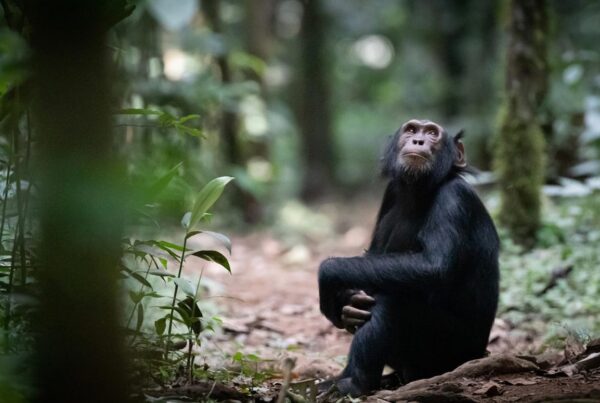
Budongo Forest is most revered for its chimpanzee population, numbering around 700 individuals, many of which have been habituated to human presence through decades of conservation and research. Chimpanzee tracking is undoubtedly the forest’s crown jewel attraction. Visitors who venture into the dense undergrowth, accompanied by experienced guides, often find themselves face-to-face with these intelligent primates, watching them forage, groom, communicate, and play. The experience is deeply moving and intellectually stimulating, often leaving a lasting impression.

Yet, chimpanzees are only part of the story. Budongo is home to eight other species of primates, including the black-and-white colobus, blue monkeys, red-tailed monkeys, olive baboons, and the elusive Potto. These primates thrive within the forest’s stratified vegetation, where canopies soar above 60 meters and provide a complex vertical ecosystem.

Botanically, Budongo is famed for its mahogany trees, some of which are over 80 meters tall. These towering giants dominate the canopy and give the forest a feeling of majestic permanence. The East African mahogany (Khaya anthotheca) and ironwood trees have made the forest a site of both ecological admiration and historical logging interest.

The forest also hosts over 360 bird species, making it a prime destination for ornithologists. Notable sightings include the puvel’s illadopsis, Ituri batis, and the chestnut-capped flycatcher. The richness of the forest’s birdlife has earned it a place on the itinerary of global birdwatching enthusiasts.

Beyond wildlife, Budongo holds archaeological and anthropological significance. Excavations and studies have shown evidence of human interaction with the forest dating back centuries, and it continues to serve local communities through sustainable harvesting and medicinal plant use.

Things to Do: Tracking, Trekking, and Awakening the Senses

The primary activity for visitors is chimpanzee tracking, which occurs twice daily and lasts between 3 to 4 hours. Visitors are guided by experienced trackers who understand chimpanzee behavior and the terrain intimately. The trek is moderate in difficulty and winds through pathways where sunlight filters through dense foliage, creating a serene and sometimes surreal atmosphere.

Nature walks and forest hikes offer opportunities for deeper exploration. The trails are designed to showcase the forest’s botanical diversity, geological features, and lesser-known wildlife. Quiet treks reveal secret clearings, ancient tree root systems, and forest elephants’ footprints, though sightings of these shy mammals are rare.

Birdwatching expeditions often begin at dawn, when bird activity is at its peak. Local guides, many of whom have grown up around the forest, possess exceptional knowledge of avian calls, habitats, and behavior, making every birding walk a rich educational experience.

The Budongo Eco Lodge also offers interpretive experiences that combine environmental education with community interaction. Guests can learn about conservation initiatives, reforestation projects, and the impact of research partnerships like the long-running Budongo Conservation Field Station, which has hosted international researchers since the 1990s.

Photography is another deeply rewarding activity in Budongo. The combination of giant trees, misty light rays, and expressive chimpanzees makes the forest a haven for both amateur and professional photographers. The ever-changing interplay of shadow and light adds a mystical quality to every shot.

Best Time to Visit: Following the Rhythms of the Forest

Budongo Forest can be visited throughout the year, but the most favorable conditions occur during the dry seasons, which run from December to February and June to August. During these months, trails remain dry and accessible, and wildlife is easier to spot due to thinner vegetation. Chimpanzee tracking success rates are particularly high in the dry season, with fewer disruptions from rain.

The wet seasons, from March to May and September to November, bring heavy rains that enrich the forest’s biodiversity and create a dramatic, verdant landscape. Though tracking becomes more challenging due to muddy conditions, the rewards for intrepid travelers include increased bird activity and the opportunity to see the forest in its full green glory.

Morning hours are considered ideal for chimpanzee tracking, as primates are most active during this period. Temperatures are cooler, and the forest comes alive with movement, sound, and color. Regardless of the season, Budongo’s evergreen canopy ensures that visitors are enveloped in a lush atmosphere year-round.

A Forest That Inspires, Heals, and Awakens

Budongo Forest is not a place that seeks attention with flamboyance or fame. Instead, it whispers its wonders to those who are willing to listen, observe, and immerse themselves in the delicate balance of life it protects. It is a destination for the curious, the reflective, and the reverent—a rare intersection of raw nature, research, and responsible tourism.

Whether watching a young chimp swing through the trees, listening to the rustle of leaves stirred by an unseen animal, or standing beneath a mahogany tree that has witnessed centuries pass, visitors come away changed. Budongo does not entertain; it enlightens.

Travel with Purpose: Explore Budongo with WildHorn Africa

For travelers seeking to experience Budongo Forest in a way that is immersive, safe, and ethically guided, WildHorn Africa offers expertly crafted itineraries that blend adventure with authenticity. Their team ensures every aspect of the journey—from transportation and permits to expert guides and conservation briefings—is seamlessly managed.

With a commitment to sustainable tourism, local community engagement, and deep ecological respect, WildHorn Africa transforms a visit to Budongo into more than a trip—it becomes a journey of understanding and connection.

Book your Africa tours and safaris with WildHorn Africa today, and step into the living story of Budongo Forest. Let the trees tower above you, the chimpanzees remind you of our shared ancestry, and the forest’s stillness speak truths words cannot.

Kalinzu Forest

Kalinzu Forest

By Uganda places to visit, Where to go

Kalinzu Forest: Uganda’s Whispering Wilderness of Primal Beauty

Hidden in the mist-clad highlands of western Uganda, Kalinzu Forest stands as a mesmerizing testament to the power of nature to heal, awaken, and astonish. This forest, dense with centuries-old trees, cloaked in veils of morning fog, and alive with the haunting calls of primates and birds, is one of the last great natural treasures in East Africa. It offers not only a sanctuary for wildlife but a portal into Uganda’s untamed soul, where every path winds deeper into a living, breathing narrative of ecological complexity and cultural significance.

In a world where natural spaces are rapidly diminishing, Kalinzu has become a cherished remnant of what the wild once was. With over 260 species of trees, hundreds of butterflies, vast bird populations, and multiple primate species, it has long drawn researchers, conservationists, and adventurous travelers alike. But this is not just a place for scientists—Kalinzu is a forest that speaks to every human heart, offering moments of serenity, wonder, and deep connection with the Earth’s original rhythms.

Location: A Forest Between Rift Valleys and Kingdoms

Kalinzu Central Forest Reserve is situated in Bushenyi District, in the southwestern region of Uganda. It borders the renowned Queen Elizabeth National Park, lying along the edge of the Great Rift Valley near the escarpments of the Albertine Rift. This positioning makes Kalinzu a critical ecological corridor that links protected areas and helps sustain biodiversity across the region.

Located approximately 375 kilometers from Kampala, the forest is part of the larger Maramagambo ecosystem and lies at an altitude of 1,400 to 1,600 meters above sea level. Its proximity to Lake Edward and the Kazinga Channel adds climatic moisture, supporting lush vegetation that remains green throughout the year. The forest is surrounded by small communities that continue to rely on it for traditional medicine, spiritual practices, and cultural heritage, making Kalinzu not only a biological haven but a deeply rooted social and spiritual landscape.

How to Get There: A Scenic Journey Into the Wild

The journey to Kalinzu Forest begins in Kampala, Uganda’s capital, and proceeds westward via Masaka–Mbarara road. This route takes travelers through sweeping savannahs, banana plantations, and rolling hills, offering glimpses into Uganda’s countryside charm. Upon reaching Bushenyi town, the forest is just a short drive away, branching off the road that leads toward Ishaka and then to Kasese.

Public buses and private vehicles serve this corridor regularly, but most travelers opt for guided tours or private transfers arranged by reputable travel companies. Those seeking a seamless experience often choose expert-curated itineraries offered by tour operators like WildHorn Africa, who handle transport, permits, and expert guides with local ecological knowledge.

Travelers arriving from Queen Elizabeth National Park can reach Kalinzu in under an hour, making it a perfect extension to wildlife safaris in the Ishasha or Mweya sectors. The forest’s elevation and surrounding views offer an immediate visual shift from the park’s savannahs to highland rainforest—a change that feels like stepping between worlds.

Attractions: Nature’s Undisturbed Symphony

Kalinzu Forest Reserve is famous primarily for its chimpanzee population, making it one of the top destinations in Uganda for chimpanzee trekking outside Kibale National Park. It is estimated that the forest harbors around 300 chimpanzees, with a habituated group of about 50 individuals open to tourist tracking. This rare opportunity to observe one of our closest relatives in their natural environment is an emotional and transformative experience, as visitors follow expert guides deep into the forest to witness intimate moments of social interaction, grooming, feeding, and play.

Yet, Kalinzu offers far more than primates. Over 410 species of birds have been recorded within its borders, including the black and white casqued hornbill, great blue turaco, and sunbirds whose plumage flashes like stained glass against the green foliage. Bird enthusiasts are often overwhelmed by the density and diversity of species, many of which are endemic to the Albertine Rift.

The forest is also home to other primates such as blue monkeys, L’Hoest’s monkeys, olive baboons, and red-tailed monkeys, all of which can be seen during treks. The undergrowth teems with reptiles, insects, and butterflies, and the thick canopy forms a cathedral-like roof where light filters through like falling stars.

Of particular interest to botanists are the numerous medicinal plant species used by surrounding communities. Many of these plants are still part of active ethnobotanical practices, and some are being studied for their pharmaceutical potential. Trees such as Prunus africana, whose bark is used to treat prostate conditions, grow abundantly here, and local guides are often willing to share traditional knowledge passed down for generations.

Things to Do: Journeys Into Silence and Discovery

The most celebrated activity in Kalinzu is chimpanzee tracking, an experience that typically begins early in the morning. With permits secured in advance, small groups of visitors follow Uganda Wildlife Authority rangers along winding trails, listening for distant vocalizations and watching for signs like nests or half-eaten fruits. The experience is immersive, with sudden bursts of emotion when the chimps are finally spotted, often swinging overhead or sitting calmly just meters away.

But Kalinzu is also a hiker’s paradise. Several well-marked trails such as the Palm Trail, Valley Trail, and River Trail wind through varied terrain, leading to spectacular lookouts over the Rift Valley, hidden waterfalls, and dense groves that echo with birdcalls. Walks range from short one-hour circuits to longer full-day excursions, all of which offer rich opportunities to appreciate the forest’s biodiversity.

Visitors can also partake in community visits, where local residents share their connection with the forest through storytelling, dance, and traditional healing demonstrations. These interactions reveal how Kalinzu is not simply a protected space, but a living part of people’s heritage, deeply intertwined with their identity and survival.

Photography enthusiasts find endless subjects—from misty forest paths and vibrant birds to curious primates and wide-angle views of the Albertine Rift escarpment. The play of light and shadow in the forest, especially in the early morning and late afternoon, transforms the reserve into a canvas of shifting beauty.

Best Time to Visit: Walking with the Seasons

Kalinzu Forest can be visited year-round, but seasonal shifts influence trekking conditions and wildlife visibility. The dry seasons, from June to August and December to February, offer the most favorable conditions for chimpanzee tracking and hiking. Trails remain dry and passable, and wildlife tends to be more active near water sources, making sightings more frequent.

The rainy seasons, especially March to May and September to November, bring intense greenery, spectacular floral blooms, and increased bird activity. While trails may become slippery, the forest takes on a mystical quality, with mist rising from the undergrowth and an amplified chorus of sounds from amphibians and birds.

Morning treks are highly recommended, as chimpanzees are more active during the early hours. Additionally, the morning light filtering through the forest creates ideal conditions for photography and enhances the ethereal feel of the experience.

A Forest That Lives in Memory

To walk through Kalinzu is to step into a world where the Earth still sings its original song. The scent of damp leaves, the distant cries of chimpanzees, the rustling of unseen creatures in the underbrush—all of it weaves a sensory tapestry that stays with you long after you leave. This forest is not only a destination but a teacher, a healer, and a reminder of humanity’s place in the great ecological story.

It is a place where modern travelers can find something ancient, where each footstep over leaf-strewn paths becomes a dialogue with nature, and where conservation is not a trend, but a deeply felt necessity.

Explore Kalinzu Forest with WildHorn Africa

Experiencing Kalinzu Forest in its full depth and beauty requires more than just a map and a desire to explore. It demands the expertise and thoughtful guidance that only seasoned professionals can provide. WildHorn Africa stands at the forefront of immersive, ethical, and unforgettable African travel.

Through carefully curated experiences that combine wildlife encounters, cultural immersion, and conservation awareness, WildHorn Africa ensures that every traveler becomes not just a visitor, but a part of Kalinzu’s enduring story. With their team handling logistics, permits, and expert guides, you are free to focus on what matters most—being fully present in one of Africa’s most enchanting forests.

Book your Africa tours and safaris with WildHorn Africa today, and let Kalinzu Forest awaken the wild within you. Let its silence speak, its canopy shelter you, and its creatures remind you of the wonder that still exists in the world.

Mabira Forest Reserve

Mabira Forest Reserve

By Uganda places to visit, Where to go

Mabira Forest Reserve: Uganda’s Lush Green Sanctuary of Life and Wonder

Deep in the heart of Uganda’s central region, halfway between the energetic buzz of Kampala and the laid-back charm of Jinja, lies a vibrant, breathing relic of the ancient world—Mabira Forest Reserve. With its dense canopies, haunting bird calls, and veils of mist that rise with the morning sun, this forest feels more like a living cathedral than a mere geographical location. Mabira Forest, stretching over 300 square kilometers, is not merely a collection of trees—it is a pulse of biodiversity, culture, and ecological balance. Every rustle in the undergrowth, every chirp in the canopy, and every whisper of wind through the leaves tells a story millennia old.

As the largest remaining natural tropical rainforest in Uganda’s central region, Mabira offers more than just visual splendor. It provides a rare window into Uganda’s rich ecological past, a refuge for endangered species, and a critical carbon sink amid rising environmental challenges. For travelers, it is a realm of discovery—offering moments of thrill, tranquility, and transformation beneath its evergreen embrace.

Location: A Forest Between Two Cities

Mabira Forest Reserve is located in Buikwe District, approximately 54 kilometers east of Kampala and about 20 kilometers west of Jinja, along the busy Kampala–Jinja highway. This strategic positioning places it within easy reach of Uganda’s major urban centers, yet far enough to preserve its serenity and wildness.

The forest spreads between the towns of Lugazi and Najjembe, nestled in Uganda’s central plateau. Surrounded by sugarcane plantations, rural communities, and the Nile Basin, Mabira provides an ecological contrast and cultural complement to its human neighbors. Its proximity to urban hubs makes it a popular escape for both domestic and international tourists seeking a taste of raw, untouched nature without venturing deep into remote wildernesses.

How to Get There: The Green Gateway Awaits

Access to Mabira Forest is straightforward and scenic. From Kampala, the journey along the Kampala–Jinja Highway takes about an hour and a half by car, depending on traffic. Public transport options such as taxis and buses are readily available from Kampala’s central terminals, with stops near the forest’s edges in Lugazi or Najjembe.

Travelers approaching from Jinja enjoy a shorter route of approximately 30 minutes, offering a smooth ride through beautiful countryside. For those opting for guided tours, trusted travel companies like WildHorn Africa provide well-coordinated itineraries that include not just transportation but also enriching commentary and expert guidance once inside the reserve.

Entry to Mabira is usually made through designated trails, particularly around the Griffin Falls Camp area or the Eco-tourism Center at Najjembe. These access points serve as hubs for organized activities and forest excursions.

Attractions: Nature’s Untamed Masterpiece

The grandeur of Mabira Forest Reserve lies not in singular attractions, but in the sheer abundance and diversity of life woven into its every layer. Home to over 300 species of birds, more than 200 species of butterflies, and over 300 species of trees and shrubs, the forest stands as a celebration of biodiversity.

One of the forest’s most celebrated inhabitants is the Lophocebus ugandae, or Uganda Mangabey, a rare and endemic primate species found only within this ecosystem. These arboreal monkeys, with their expressive faces and shaggy coats, embody the unique evolutionary journeys that Mabira has nurtured for centuries. Sightings of red-tailed monkeys, grey-cheeked mangabeys, and colobus monkeys add to the primate spectacle, each encounter reminding visitors of the forest’s delicate and precious web of life.

Birdwatchers are treated to a symphony of colors and calls. Species such as the African pied hornbill, Nahan’s francolin, and forest wood hoopoe animate the canopy, turning every walk into an auditory and visual treasure hunt. Butterflies shimmer along sun-dappled trails, their wings catching light in brilliant iridescence. Tree lovers and botanists find endless fascination among ancient mahoganies, fig trees, and rare orchids thriving in the forest’s humid understory.

While the flora and fauna reign supreme, the forest also holds hidden natural wonders such as Griffin Falls, a gentle cascade that emerges from the woods and offers a cool, tranquil escape amid the trees. The sound of water weaving through roots and stones adds a soothing rhythm to the already hypnotic forest ambiance.

Things to Do: A Symphony of Sensory Experiences

Nature walks within Mabira are the most immersive way to engage with the forest’s magic. Guided by local experts or forest rangers, these treks reveal layers of ecosystem interactions, folklore, and conservation challenges. Paths wind beneath towering trees, through bamboo thickets and swampy glades, leading explorers into the heart of green silence punctuated only by the calls of nature.

For adrenaline seekers, canopy zip-lining at Griffin Falls is a thrilling highlight. Suspended above the treetops, visitors glide through the forest like birds, gaining a panoramic view of the green expanse below and a heart-pounding perspective on Mabira’s vastness. The experience combines adventure with an unmatched sense of elevation—both physical and emotional.

Cultural interactions offer another dimension to the forest experience. Local communities surrounding the reserve have long held spiritual and traditional ties to the land. Engaging with their stories, crafts, and forest-related practices provides insights into how humans can live in respectful harmony with nature. Traditional herbalists often share their knowledge of forest medicine, and local guides speak passionately about legends and ancestral tales tied to various parts of the forest.

Cycling along designated forest trails adds a dynamic element to exploration, allowing deeper penetration into areas less trodden by foot. For birders, patient stakeouts along swampy margins or fruiting trees yield extraordinary rewards. And for those simply seeking tranquility, Mabira offers numerous picnic sites and quiet nooks where one can meditate, read, or listen to the forest breathe.

Best Time to Visit: Tuning into the Forest’s Rhythm

Mabira Forest Reserve is a year-round destination, but seasonal variations influence the type of experience one can expect. The dry seasons, typically from December to February and from June to August, are ideal for hiking, birdwatching, and zip-lining. Trails remain dry and accessible, and visibility within the forest canopy improves as vegetation thins slightly.

The wet seasons, especially March to May and September to November, bring a different beauty. The forest becomes denser and more vibrant, saturated in shades of green. While trails may become slippery, the increased rainfall attracts a surge in bird activity and butterfly emergence, creating unparalleled photographic opportunities. However, visitors during these months should be prepared for humidity and occasional heavy showers.

Morning hours tend to be the most active and rewarding for wildlife viewing, as birds sing at their loudest and monkeys are seen foraging. Regardless of the season, the forest offers an evocative escape into a world where time slows, senses heighten, and nature reveals its secrets at a steady, unhurried pace.

Beyond the Trees: Mabira’s Role in Conservation and Culture

More than a tourist destination, Mabira Forest Reserve plays a critical role in Uganda’s environmental resilience. As a catchment area for rivers and streams, it supports surrounding agriculture and communities. It serves as a climate regulator, a carbon sink, and a genetic reservoir for medicinal plants and threatened species.

Conservation efforts in Mabira are ongoing, often in partnership with local communities, NGOs, and government bodies. Despite past threats of deforestation and encroachment, the forest remains a battleground for environmental advocacy and sustainable land use. Every visitor who treads its trails or contributes to its ecotourism economy becomes part of a larger narrative—a movement to preserve what remains of East Africa’s primordial forests.

Mabira is also a living cultural landscape. Sacred groves within the forest are still used for traditional ceremonies. Oral histories speak of kings, gods, and warriors who sought refuge or blessings under its trees. In this way, the forest serves not just as an ecological marvel but also as a repository of spiritual and cultural identity.

Explore Mabira Forest Reserve with WildHorn Africa

To unlock the full magic of Mabira Forest Reserve, the guidance of experienced and passionate travel professionals is essential. With its in-depth knowledge of Uganda’s ecological and cultural tapestry, WildHorn Africa offers tailored journeys into the forest that are both adventurous and meaningful.

Whether it’s your first nature walk or a return to reconnect with ancient roots, WildHorn Africa ensures your experience is safe, informative, and impactful. Their commitment to sustainable tourism, cultural respect, and conservation partnerships makes them an ideal companion for responsible travelers.

From arranging expert guides and safe transport to curating moments of awe, WildHorn Africa turns a visit to Mabira into a transformative African encounter. Let them lead you into the green cathedral of Uganda—where stories are whispered by trees, and the heartbeat of the forest resonates with your own.

Book your Africa tours and safaris with WildHorn Africa, and let Mabira Forest Reserve be the breath of fresh air that reawakens your love for wild, sacred nature.

Itanda Falls

Itanda Falls

By Uganda places to visit, Where to go

Itanda Falls: Uganda’s Roaring Jewel of the Nile

In the heart of Uganda, where the legendary Nile River thunders over jagged rocks and plunges into fierce white foam, Itanda Falls emerges as a raw, untamed symbol of Africa’s natural power. While the world has long revered the Nile for its historical significance and geographic magnitude, it is in places like Itanda that the river’s true spirit comes alive—wild, commanding, and unrelenting. Far from the tranquil bends often associated with the Nile’s journey, this stretch reveals the river’s muscular might, drawing thrill-seekers, nature lovers, and cultural explorers alike.

Surrounded by thick vegetation and serenaded by the thunder of crashing water, Itanda Falls is not just a visual marvel but an immersive experience. It commands attention not by its height, but by the force of its rapids, the speed of its flow, and the sacred aura that lingers in its spray. As one of Uganda’s best-kept secrets—still gloriously unspoiled by over-commercialization—Itanda stands tall as a hidden treasure for adventurers and spiritual travelers alike.

Location: A Hidden Treasure Near Jinja

Situated approximately 27 kilometers northwest of Jinja City, Itanda Falls lies along the course of the Victoria Nile, just beyond the areas frequented by casual tourists. The falls are found in Itanda Village, in Budondo sub-county, nestled within a tranquil setting that belies the thunderous energy of the falls themselves.

This part of the Nile slices its way through ancient rocks and dense greenery, creating a dramatic and humbling landscape that feels both primal and majestic. Unlike other more developed sites along the Nile, Itanda remains blessedly authentic, maintaining the natural integrity of the river and its surroundings. Here, the river is not confined, redirected, or muted—it flows freely and defiantly, as it has for centuries.

The surrounding area is primarily rural, with communities of the Basoga people living in harmony with the river, drawing from its resources for fishing, farming, and cultural ceremonies. Their presence adds a rich layer of tradition and spiritual reverence to the experience of visiting the falls.

How to Get There: Journeying to the Roar

Getting to Itanda Falls from Kampala, Uganda’s capital city, is a rewarding journey that stretches about 85 kilometers and typically takes 2 to 3 hours by road. The drive heads east via the Kampala-Jinja Highway, a route that unveils Uganda’s diverse scenery—rolling hills, busy trading centers, and the iconic crossing over the Source of the Nile at Jinja.

Once in Jinja, the road diverts northward through rural villages and eventually leads to Itanda, via dirt roads that wind through plantations and forests. The last leg of the journey may require a four-wheel drive vehicle, especially during the rainy season, when the terrain becomes muddy and challenging. Despite the ruggedness, the route to Itanda offers glimpses into daily rural life—children herding goats, farmers in banana groves, and locals cycling along red-earth paths.

Private guides and tour companies such as WildHorn Africa make this journey smoother, providing not just transport but also expert insights into the region’s geography, history, and culture. Their presence ensures that the visitor’s experience is both enriching and hassle-free.

Attractions: A Symphony of Water and Power

The most striking feature of Itanda Falls is its series of powerful rapids, graded up to class V and VI, which make it one of the most challenging and awe-inspiring sections of the Nile. Unlike vertical-drop waterfalls, Itanda is characterized by long stretches of foaming white water, crashing over black basalt boulders in rapid succession. The sound is deafening; the mist, intoxicating.

The falls are visually mesmerizing, with multiple channels of water splitting, rejoining, and tumbling over rocks in a chaotic yet beautiful rhythm. The spray rises into the air, catching the sunlight in occasional bursts of rainbow. Along the banks, fig trees and papyrus reeds frame the scene, adding texture to the landscape and offering shade for quiet contemplation.

While once relatively unknown, Itanda Falls has risen in prominence among white-water rafting and kayaking communities, attracting elite paddlers from across the globe who seek the ultimate test of river navigation. But beyond adventure sports, the site also draws spiritual pilgrims, local traditionalists, and photographers, all lured by the falls’ magnetic power.

Things to Do: Thrill, Tranquility, and Cultural Discovery

The most iconic activity at Itanda Falls is undoubtedly white-water rafting. For those daring enough to confront the Nile at its fiercest, this section offers one of the most exhilarating white-water experiences on the African continent. International rafting expeditions have frequently classified Itanda as a must-visit due to its sheer force, complex rapids, and thrilling unpredictability.

Kayaking and riverboarding are also pursued by more experienced adventurers, but these activities are typically reserved for professionals due to the dangerous currents and technical skill required.

For those seeking a quieter connection with the river, guided nature walks around the falls provide a chance to appreciate the area’s botanical and ecological richness. Trails meander through forests and farmlands, offering views of the river from various elevations. Birdwatchers often spot kingfishers, herons, and cormorants, while butterflies flit across the trails in kaleidoscopic bursts of color.

Cultural experiences are equally rewarding. Visitors may encounter traditional healers or spiritual leaders who conduct rituals at the river’s edge, reinforcing the falls’ status as a sacred site. Some believe that the spirit of the Nile dwells in the waters of Itanda, and local myths often reference ancestral connections to the river.

A visit to Itanda is also incomplete without engaging with the Basoga communities nearby. Their hospitality, storytelling, and musical performances enrich the experience with a human dimension that contrasts beautifully with the rawness of the river.

Best Time to Visit: Following the Rhythm of the Nile

Itanda Falls can be visited throughout the year, but the most favorable months are during the dry seasons—from June to August and again from December to February. During these months, the paths are more navigable, the weather is reliably sunny, and river conditions allow for the best combination of safety and excitement.

In the wet seasons, particularly between March to May and September to November, the volume of water surging through the falls increases dramatically. While this amplifies the spectacle of the falls and enhances their photographic drama, it can also limit access and raise safety concerns for water sports. Nonetheless, those willing to brave the rain are rewarded with fewer crowds and a deeper sense of immersion.

For cultural travelers, visiting during local festivals or ceremonies—often aligned with the lunar calendar—offers deeper insight into the region’s traditions. During these events, the falls often become a spiritual stage, echoing not only with water but with drums, chants, and community prayers.

Beyond the Falls: A Place of Reflection and Reverence

More than a destination for thrill-seekers, Itanda Falls offers something profound—a reminder of nature’s ability to awe, to humble, and to heal. Standing beside the roaring rapids, one cannot help but feel the pulse of Africa itself. The rhythm of the river becomes the rhythm of breath, and the sheer scale of its power forces a moment of reflection, of surrender, of gratitude.

In an age of digital distraction and environmental degradation, places like Itanda serve as vital sanctuaries. They preserve not only ecosystems but also intangible heritage—the myths, stories, and spiritual practices that have bound people to the Nile for generations. Here, the river is not a background element; it is the protagonist in a story still being written.

Itanda Falls remains off the beaten track for many travelers, but perhaps that is its greatest strength. Its authenticity, its refusal to be tamed, and its embrace of those who seek truth and adventure all combine to make it a destination worth discovering—not just once, but again and again.

Experience Itanda Falls with WildHorn Africa

For travelers who wish to go beyond the ordinary and embrace Uganda’s most authentic natural treasures, WildHorn Africa stands ready to guide you. With deep roots in the region, a commitment to responsible tourism, and expert knowledge of East Africa’s hidden gems, WildHorn Africa curates journeys that celebrate adventure, culture, and conservation.

Whether your heart beats for the thrill of rafting, the serenity of riverside walks, or the spiritual echoes of ancient lands, WildHorn Africa offers personalized, seamless, and transformative experiences. Let your journey to Itanda Falls and beyond be not just a vacation—but a profound encounter with Africa’s soul.

Sipi Falls

Sipi Falls

By Uganda places to visit, Where to go

Sipi Falls: Eastern Uganda’s Cascading Masterpiece of Nature

Tucked into the dramatic foothills of Mount Elgon, where green-cloaked cliffs tumble into the plains and coffee farms cling to the highlands like emerald patchwork, Sipi Falls rises—literally and metaphorically—as one of Uganda’s most spectacular natural wonders. Composed of a trio of powerful waterfalls that plunge over ancient basalt cliffs, Sipi Falls is more than a scenic spectacle—it is a sensory experience. The roar of cascading water, the mist kissing your skin, the sight of lush vegetation clinging to volcanic slopes, and the scent of freshly roasted Arabica coffee—it all forms a symphony of raw nature that draws adventurers, photographers, nature lovers, and peace-seekers alike.

Often referred to as the “gem of Eastern Uganda,” Sipi Falls lies in a region where time seems to move at a gentler pace, and where every viewpoint offers a poetic frame of Africa’s unspoiled beauty. But beyond its dramatic waterfalls lies a deep cultural, ecological, and geographical richness that continues to position Sipi as a premier destination for both domestic and international travelers.

Location: A Highland Retreat Beneath Mount Elgon

Sipi Falls is located in the Kapchorwa District of eastern Uganda, on the northwestern slopes of Mount Elgon, near the Kenyan border. Sitting at an altitude of approximately 1,775 meters above sea level, the area enjoys a cooler and more temperate climate than many other parts of the country.

The region forms part of the greater Mount Elgon National Park, a UNESCO Man and Biosphere Reserve known for its biodiversity, montane forests, and the world’s largest volcanic caldera. The falls themselves are fed by the Sipi River, which meanders down from Mount Elgon and eventually flows into the Kyoga Basin. The highest of the three falls drops from a staggering height of 100 meters, while the other two measure about 85 meters and 65 meters, respectively.

This altitude and geography give Sipi not only its stunning visual appeal but also its lush environment—home to banana plantations, native forests, and the world-famous Bugisu Arabica coffee. The community here remains tightly knit, and the cultural traditions of the Sebei people blend harmoniously with the surrounding landscape.

How to Get There: A Journey into the Eastern Highlands

Reaching Sipi Falls from Uganda’s capital, Kampala, requires a scenic road trip of approximately 280 kilometers, which typically takes 5 to 6 hours by car. The journey begins on the main eastern highway, passing through Jinja and Mbale, two historically significant towns in Uganda’s colonial and cultural story.

From Mbale, a bustling town with a blend of colonial architecture and modern markets, the road climbs steadily into the Elgon foothills. As one ascends into Kapchorwa, the air grows cooler, and the landscape transitions into a green mosaic of farms, villages, and towering cliffs. The final stretch to Sipi is best navigated in a four-wheel-drive vehicle, particularly during the rainy season when some road sections may be slippery or washed out.

For those seeking convenience, private tour operators like WildHorn Africa provide tailored transport and guiding services that combine comfort with expert regional knowledge, turning the journey itself into a rewarding part of the adventure.

Attractions: Nature’s Grandeur in Triple Form

The three waterfalls that make up Sipi Falls are naturally arranged along the Sipi River and spread out across a few kilometers, each offering a distinct perspective on the landscape and delivering unique photographic and sensory experiences.

The main waterfall, the tallest and most iconic, is the one most often associated with Sipi. It plunges over a cliffside that has been carved by centuries of erosion, falling into a deep gorge surrounded by hanging vines, birdsong, and fern-covered rocks. On sunny days, a rainbow often appears in the mist, creating a scene so surreal it could be mistaken for fantasy.

The second and third waterfalls, though slightly smaller, offer more secluded and intimate encounters with the terrain. They are hidden along winding trails that pass through local farms and forests, making their discovery feel like stumbling upon a well-guarded secret. Along these trails, travelers often encounter vibrant butterflies, curious children, and locals drying coffee beans under the sun.

In addition to the waterfalls, the area is a sanctuary for biodiversity, with rare plant species, over 200 recorded bird species, and frequent sightings of monkeys and chameleons. At night, the skies above Sipi open up in a celestial display that delights stargazers, with minimal light pollution offering unobstructed views of constellations.

Things to Do: Adventures and Immersion in Nature and Culture

Hiking is undoubtedly the most popular activity at Sipi Falls, with numerous trails connecting the three waterfalls and extending into the larger Mount Elgon ecosystem. These hikes vary in difficulty and duration, but all share one thing in common: breathtaking views and immersive encounters with nature. Guided hikes led by local community members not only enrich the experience with storytelling and cultural context but also support the area’s eco-tourism efforts.

Rock climbing has also become increasingly popular in the Sipi region, especially on the basalt cliffs near the main falls. With routes suited for both beginners and experienced climbers, the sport adds an adrenaline-pumping dimension to the otherwise serene environment.

Another deeply rewarding experience is the coffee tour—a journey into the heart of Bugisu Arabica coffee production. Guests are welcomed into the homes of local farmers, where they are taken through the entire coffee-making process, from bean to cup. Roasting beans over an open fire, grinding them by hand, and sipping freshly brewed coffee while overlooking the valley offers an unforgettable cultural immersion.

For those seeking relaxation, sunset viewing along the cliffs of Sipi offers moments of near-spiritual calm. The golden hues bathe the valley below, and as the sun sinks behind the mountains, the entire landscape is transformed into a living painting.

Best Time to Visit: When Sipi Sings Its Loudest

Sipi Falls is a year-round destination, but the dry seasons between June and August, and again from December to February, are considered ideal for travel. During these months, the trails are easier to navigate, the skies are clearer, and the visibility of the falls is at its peak. This is also when coffee harvesting is at its height, adding another layer of activity and engagement to a visit.

The wet seasons, which typically run from March to May and September to November, offer a different, wilder beauty. The waterfalls roar more fiercely, the vegetation glows greener, and the mist creates a mystical atmosphere. While some hiking paths may be more challenging, the rewards are often worth the extra effort.

Travelers during the rainy months should be prepared for sudden weather changes, but with proper gear and local guides, the experience can be even more enchanting.

Why Sipi Falls Matters: A Sanctuary of Earth, Water, and Soul

In a world increasingly dominated by noise, speed, and distraction, Sipi Falls stands as a sanctuary of natural rhythm and quiet majesty. Here, nature is not fenced in or artificial; it breathes freely, cascades wildly, and shelters life in its most organic form. It is a place that inspires, whether through the adrenaline of adventure, the warmth of cultural exchange, or the sheer visual poetry of its waterfalls and valleys.

Yet what makes Sipi truly exceptional is not just its scenery, but the symbiosis between community and environment. The people of Kapchorwa live with the land, not against it. Their respect for the water, the forest, and the hills is embedded in their stories, songs, and daily rituals. Visiting Sipi is not just about witnessing nature’s power—it’s about participating in a culture that reveres it.

Book Your Journey with WildHorn Africa

To explore the awe-inspiring beauty of Sipi Falls and the surrounding wonders of Eastern Uganda, there’s no better companion than WildHorn Africa. With their commitment to responsible tourism, deep local connections, and seamless logistical planning, WildHorn Africa ensures that your journey is not just a trip, but a transformative experience.

Whether you’re hiking through ancient trails, savoring local coffee, or standing in the spray of a 100-meter-high waterfall, WildHorn Africa brings Uganda to life in a way few others can. For unforgettable safaris, mountain treks, cultural immersions, and hidden gems like Sipi, trust WildHorn Africa to lead the way.

Close Menu